
What are some common symptoms of autism spectrum disorder?
Autism can be challenging to understand because it’s a spectrum. No two children with autism are exactly alike. One child may show many signs, while another may only show one or two. Having certain traits doesn’t automatically mean a child will be diagnosed with autism.
I knew something was different about my son, Grayson, when he was 13 months old. I wouldn’t say I went through the classic “stages of grief,” but I did experience many emotions as I came to terms with the possibility that Grayson was autistic.
I spent a lot of time searching for the signs and symptoms of autism. I’m not sure if I was trying to convince myself my instincts were wrong, or if I was looking for confirmation that they were right. Either way, I found myself researching it almost every day.
What I want to be very clear about is that autism is a spectrum. I know I’ve said this before, but when you’re a parent—or a grandparent, aunt, uncle, or caregiver—looking up the signs and symptoms of autism, it can feel overwhelming and even terrifying.
If you suspect your child may be autistic and you’re researching the signs, please remember this: just because your child doesn’t show every sign does not mean they aren’t autistic. At the same time, showing one or two traits does not automatically mean they are.
Here are two real-life examples:
My son, who is diagnosed with ASD, shows many of the commonly listed signs. However, he does not resist physical contact—he actually loves it. He also doesn’t struggle when our routine changes, doesn’t have phobias, and isn’t aggressive or self-injurious. Even though he doesn’t display all the symptoms, he still falls on the spectrum.
My daughter, who is not autistic, is extremely sensitive to food textures and tastes. But having this one trait alone does not make her autistic.
This is exactly why it’s so important to remember that autism looks different in every child.
Does that make sense?
Autism is complex because every child on the spectrum is very different. That said, many of the signs and symptoms can be grouped into a few major categories that are commonly seen in children with autism.

What are some common signs of autism?
- Avoiding eye contact
- Have difficulty comprehending the emotions and feelings of others
- Struggling with social skills and being withdrawn from others
- Flaps hands, spins, and/or rocks
- Speech delays or the absence of speech and communication skills
- Display sensory issues (tastes, textures, smells, sounds)
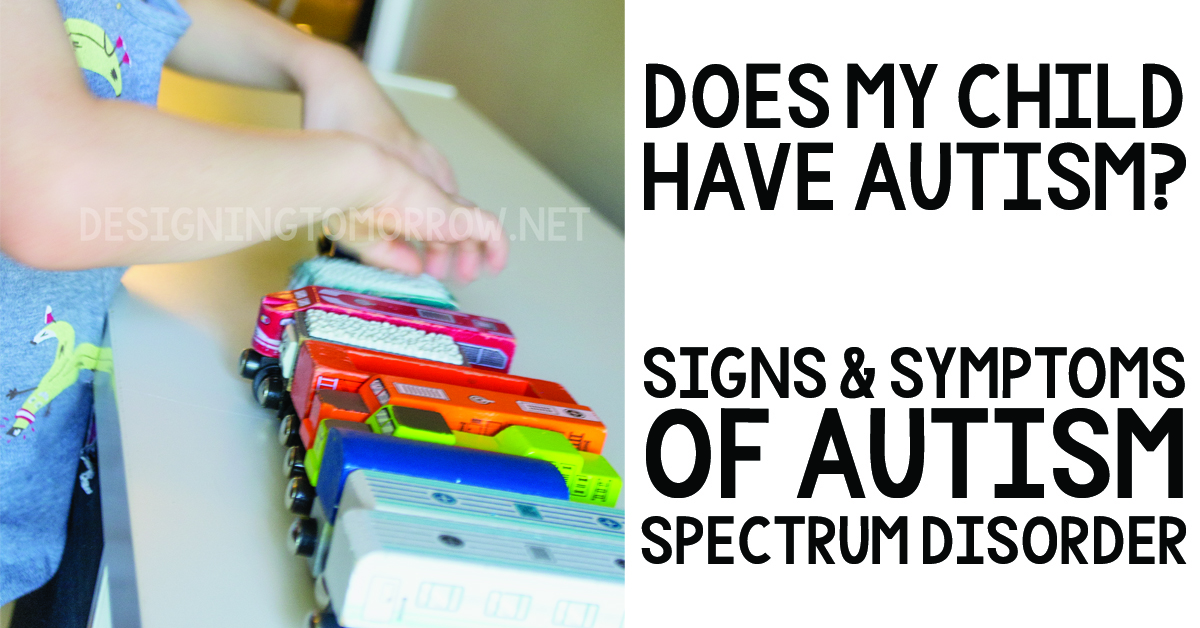
- Lining up toys or other objects
- Repeat phrases over and over again
- Obsess over particular interests
- Gets distressed over minor changes
Some common early signs of Autism:
- A child NOT responding to their his/her name (the child may appear deaf)
- Not pointing at objects or things of interest, or demonstrating interest
- Not playing “pretend” games
- Play with toys the same way every time
- Avoid or resist physical contact
- Demonstrate little safety or danger awareness
- Reverse pronouns (e.g., says “you” instead of “I”)
Other symptoms and signs of Autism:
- Have unusual interests and behaviors
- Have extreme anxiety and phobias, as well as unusual phobias
- Like parts of objects (e.g., wheels)
- Become upset by minor changes
- Give unrelated answers to questions
- Hyperactivity (very active)
- Impulsivity (acting without thinking)
- Short attention span
- Aggression
- Causing self injury
- Meltdowns
- Unusual eating and sleeping habits
- Unusual mood or emotional reactions
- Lack of fear or more fear than expected
Now that those signs and symptoms are out there (you can find links to all of my resources at the end of this article), are you feeling more or less confident about your suspicions? I found a really great resource for screening your child for autism – which may help you in this part of the journey.

If you’ve read all of those symptoms and you’re feeling like your child may have ASD, here are my recommendations on the steps you should take next!
Words of wisdom from someone who has been there:
I’ve learned so much on this journey with Grayson. In the beginning, I was scared and devastated. The depression was very real, and it was a painful place to be. It can feel lonely, overwhelming, and heartbreaking. It’s almost like everything you dreamed of for your precious child has been shattered in an instant, taking a piece of your heart with it.
But there is light at the end of the tunnel. It is going to be okay—I promise.
Grayson is still the same sweet, precious little love bug he has always been. He is still going to do amazing things in his life, and I truly believe God has placed him here for a purpose.
Don’t be afraid to talk to your pediatrician. Seek out therapies for your child. Don’t try to hide the struggles from the educators in your child’s life—they will notice anyway, I promise. If you don’t find the right help at first, keep looking. Keep asking. Keep fighting. Early intervention is so important, and you are your child’s biggest advocate.
So as hard as it is—believe me, I’ve been there—have a good cry, take a deep breath, pick yourself up, and start fighting for your precious one in every way you can.

I love the saying that autism is less of a disability and more of a unique way of seeing the world.
Do you suspect your little one may have autism spectrum disorder? Click here to see what to do next.
Please note: This article is from my personal experience and research. The very best thing to do is to speak to your child’s pediatrician!
Sources:
- https://nationalautismassociation.org/resources/signs-of-autism/
- https://ada.com/signs-of-autism/
- https://www.autismspeaks.org/signs-autism
- https://www.cdc.gov/ncbddd/autism/signs.html
- https://www.helpguide.org/articles/autism-learning-disabilities/does-my-child-have-autism.htm
- https://www.medicinenet.com/autism_symptoms_and_signs/symptoms.htm


I agree with you 100% my son who is 13 was tested and wasn’t diagnosed but the doctor said he was so close to beibg diagnosed. I diagnosed him. When he was a baby I seen him different buy at the time I wasn’t thinking about autism. The school days are when I knew he was different in some ways and I started when he was 3/4 getting him help. He is the most loving boy ever but most don’t see that in him. This road has been long and we still have a way to go. Thanks for sharing. I may do the same one day soon. It could help others understand their child or other children.